

Knowing how to build resilience in school-age kids isn’t about being perfect – it’s about helping them practice small habits that build emotional strength over time. When children learn to face challenges with courage and calm, they become more confident navigating a world that doesn’t always go as planned.
According to the American Academy of Pediatrics, resilience helps kids manage stress, adapt to change, and bounce back from disappointment – all essential for long-term mental health (AAP, 2021).
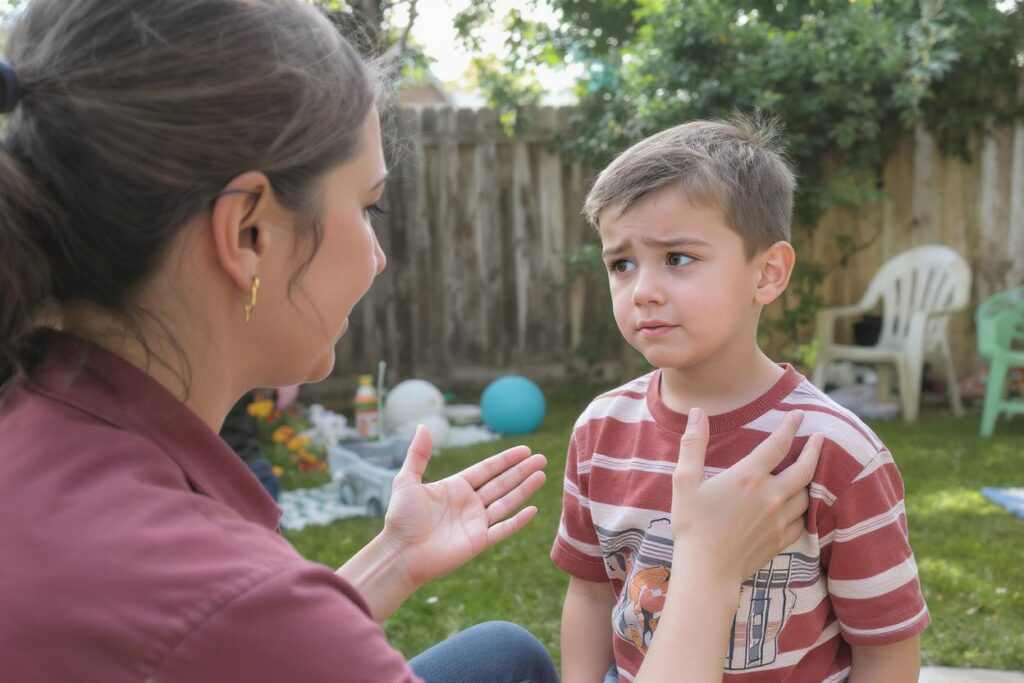
What Does Resilience Really Look Like?
Resilience isn’t just “toughing it out.” For kids, it shows up in moments like:
- Calming down after a frustrating game
- Asking for help instead of giving up
- Trying again after getting something wrong
The good news? Resilience can be taught and modeled at home—in small, doable ways. Here’s how:
1. Model Calm, Even in Chaos
- Narrate your own coping: “I’m feeling stressed, so I’m taking deep breaths”
- Let kids see how you manage hard moments without blaming or snapping
- Avoid trying to “fix” everything—focus on staying grounded together
Try This: The next time something small goes wrong (spilled milk, traffic delay), name your feeling and your coping choice out loud.
Reflect: How does your child respond when you stay calm?
Age idea:
- Ages 5–8: Use simple language like “I need a minute to calm down.”
- Ages 9–13: Talk about more nuanced feelings and responses (stress vs. disappointment).
2. Encourage the Effort, Not Just the Outcome
- Praise how your child tries, even if the result isn’t perfect
- Use phrases like “You really stuck with that!” or “You kept going even when it got hard.”
- Avoid overpraising—focus on authentic observations
Try This: When your child finishes a tough task, ask: “What helped you keep going?”
Reflect: What kinds of praise seem to build your child’s confidence?
Age idea:
- Ages 5–8: Reinforce moments of trying again after frustration
- Ages 9–13: Discuss how effort connects to long-term growth
3. Let Kids Face (Small) Challenges
- Resist the urge to jump in immediately
- Help your child brainstorm possible solutions instead of offering quick fixes
- Celebrate small wins when they solve something on their own
Try This: When your child asks for help, pause and say, “What do you think might work here?”
Reflect: What happened when your child had space to try?
Age idea:
- Ages 5–8: Practice short wait times before helping
- Ages 9–13: Encourage goal-setting and problem-solving independently
4. Make Room for Big Emotions
- Validate your child’s feelings before offering advice
- Use open phrases like “That sounds really hard. Want to talk about it?”
- Avoid rushing them through emotions with “You’re fine” or “It’s not a big deal”
Try This: Keep a “feelings chart” visible at home and use it during check-ins.
Reflect: How often does your child feel heard when they’re upset?
Age idea:
- Ages 5–8: Use simple visuals and words to talk through emotions
- Ages 9–13: Encourage journaling, drawing, or walks to process stress
5. Create Routines That Feel Safe and Predictable
- Stick to consistent sleep, meal, and school prep routines
- Use checklists or visual schedules for transitions
- Predictability helps reduce anxiety and boosts self-trust
Try This: Post a daily “What’s Coming Today” note on the fridge.
Reflect: What part of your child’s day seems to go more smoothly with structure?
Age idea:
- Ages 5–8: Use simple, colorful visuals
- Ages 9–13: Involve them in planning and adjusting routines
Frequency Asked Questions
Q: My child cries or shuts down easily—does that mean they’re not resilient?
A: Not at all. Resilience doesn’t mean avoiding emotions—it means learning how to move through them over time. Big feelings are part of the process.
Q: How can I help without hovering?
A: Think of yourself as a guide. Offer support, ask open questions, and celebrate small steps toward independence.
Q: What if I’m still working on my own resilience?
A: Great! When you show your child that you’re learning too, you model growth. Kids don’t need perfect parents – they need honest, present ones.
Support Emotional Strength at Every Age
Knowing how to build resilience in school-age kids starts with simple daily habits that help them feel heard, capable, and calm. From naming feelings to letting them wrestle with tough moments, each small step adds up to a stronger, more adaptable child.
Parent Pathways Academy offers family check-ins, easy daily tips, and supportive activities that help families grow together through every up and down.
Explore more confidence-building tools at Parent Pathways Academy.
References
American Academy of Pediatrics. (n.d.). Building Resilience in Children. HealthyChildren.org. Retrieved from https://www.healthychildren.org/english/healthy-living/emotional-wellness/building-resilience/pages/building-resilience-in-children.aspx
Center on the Developing Child at Harvard University. (2023). Resilience. https://developingchild.harvard.edu/science/key-concepts/resilience/